
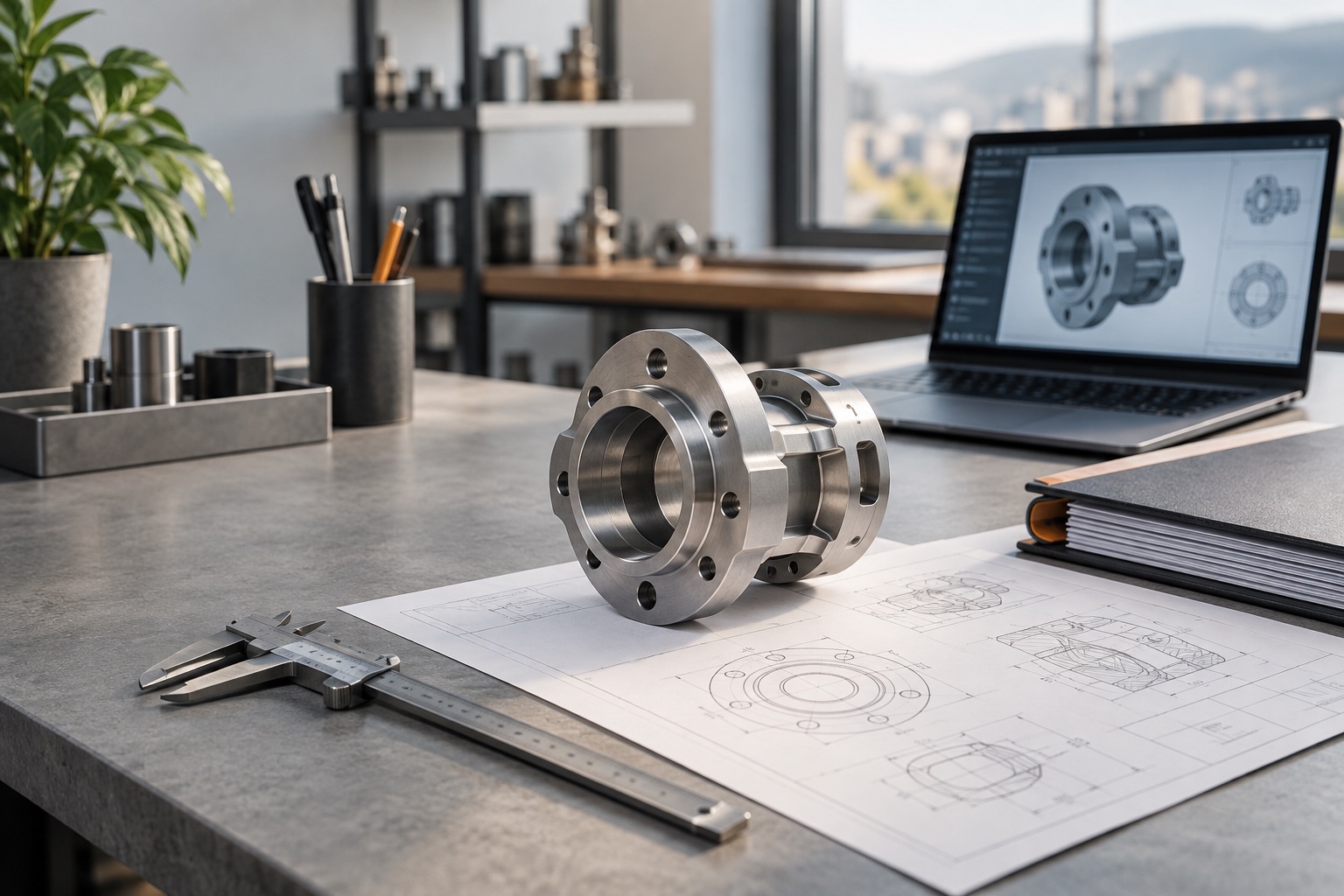
Think like the person checking a supplier. The first visit is often not a full tender. It is a quick test: does this product fit the use case, can the supplier provide the right proof, and is the next conversation worth starting?
Start with the application, not the catalogue
A technical buyer rarely begins with your internal product taxonomy. They begin with a part, a process, a problem or a target specification. Put the relevant use case near the top of the page and connect it to the exact product family, limits and next step.
For a company based in Poland, Czechia, Italy, France, the Netherlands or Denmark, the German page should also make the real setup visible: where the company is located, where it delivers or works, which languages are available and who answers an enquiry. A German route does not require an invented German branch.
Build an evidence stack
A useful product page lets a buyer move from orientation to verification without downloading a collection of unexplained files. Keep the information concise, but make the scope of every claim clear.
- Application: what the product is used for, and where it is not suitable.
- Specification: dimensions, materials, tolerances, variants or operating conditions that genuinely apply.
- Process: manufacturing, testing, configuration, packaging, delivery or installation where relevant.
- Proof: real drawings, certificates, test reports, photographs or references with an identifiable scope.
- Next step: catalogue request, technical question, sample request or structured RFQ.
Do not hide the important facts in a picture or a PDF alone. Selectable text, descriptive headings and a clear download label help people and search systems understand the page.
Explain compliance without making the website a certificate
Product requirements depend on the product, its intended use and the applicable rules. The EU explains that CE marking is required only where harmonised EU rules specifically require it; it is not a general quality badge. The manufacturer remains responsible for determining the applicable requirements and keeping the supporting documentation current.
That makes a good website boundary important: list the documents that are actually available, state their scope and mark points that need specialist review. Do not write that a product is compliant, safe or approved unless the responsible party has verified the exact statement.
Make the RFQ the natural next step
A German buyer should not have to write a complete technical brief just to find out whether a conversation is possible. Ask only for the information that helps the first response:
Application, quantity and timing.
Combine product or drawing, intended use, estimated volume, delivery region and target date. Let the visitor add a file when a drawing or specification is necessary.
Say what happens next.
Explain who reviews the request, what information may be missing and whether the next step is a technical call, sample, catalogue or quotation.
Localise the decision, not just the words
A Polish engineering supplier may want to show cross-border delivery and German contact hours. An Italian design manufacturer may need more visual context and material terminology. A Dutch technical service provider may need a precise service area and response route. A Czech manufacturer may need the German wording for its production methods and quality evidence. These are content decisions, not automatic translation settings.
Use the German website checklist for the wider structure, then use the contact-form guide to keep the first request proportionate.
A practical pre-publication check
- The first screen names the product, application and intended German audience.
- Technical claims have a defined scope and a person responsible for checking them.
- Downloads have useful names, current versions and accessible text alternatives where needed.
- The real company location, delivery area, service languages and response route are visible.
- The form accepts the information and files needed for a first assessment without demanding a full tender.
- Product, Article, Breadcrumb and FAQ data describe content that is visible on the page.
Questions companies ask
Does a German product page need the complete catalogue?
Not always. A focused first version can prioritise the products and applications most relevant to the chosen German audience. The rest can remain available through a clearly labelled catalogue route.
Can a website certify our product for Germany?
No. A website can organise and explain documents, but the responsible manufacturer or specialist must determine and verify the applicable product requirements.
What should the first enquiry ask for?
Ask for the minimum information needed to assess fit, such as application, quantity or scope, delivery area, timing and relevant documents.
Your Europe: general product compliance · Your Europe: CE marking · Google Search Central: Product structured data
Checked 18 September 2026. This is general content guidance, not product, legal or conformity advice.
Turn technical material into a clear German route.
Send your current product pages, documents and the German audience you want to reach.
Open the enquiry form