AVOGAVOGGerman market websites
German web design for international businesses

Your business.
Ready for Germany.

AVOG helps companies from Poland, Czechia, the Netherlands, Italy, France and other European markets present their offer clearly to German customers, buyers and partners.

German-first contentSEO and GEO foundationsB2B enquiry routes
Make the
next step
obvious.
For German prospects

What do you offer, who is it for, where do you deliver and how should someone enquire?

CLEAR
LOCAL
USEFUL
Find the right starting point

What should the German version make easier?

Choose the commercial task first. The website structure follows the decision your German audience needs to make.

01 / 03Three short questions

What matters most right now?

Built around the sector

The proof changes with the business.

A German market website should show the facts that help a specific audience decide. Select a starting point.

For purchasing teams

Make capacity and fit easy to verify.

Show products by application, materials, tolerances, lead times, delivery area and documentation. A structured request-for-quotation path can ask for the detail a buyer already has to prepare.

  • Product and application pages
  • Technical documents and proof
  • German RFQ or catalogue request
For German guests

Let people decide and book with confidence.

Present rooms or tables, location, opening hours, menu or facilities, accessibility and the direct booking route in German. The website can connect to an existing booking system instead of replacing it.

  • German room, menu or experience pages
  • Location, arrival and practical information
  • Booking or reservation integration
See the difference

Translation is not the whole change.

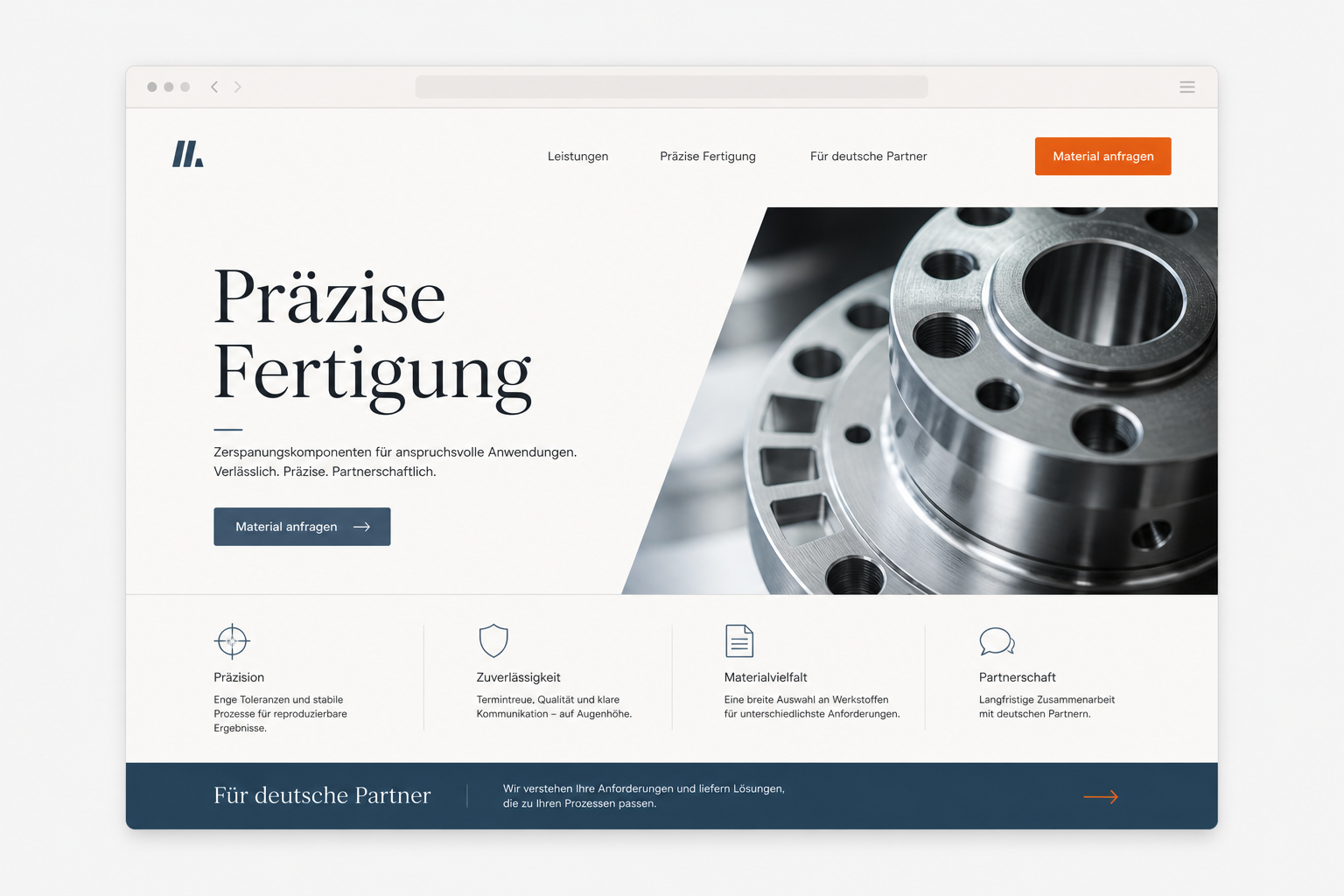
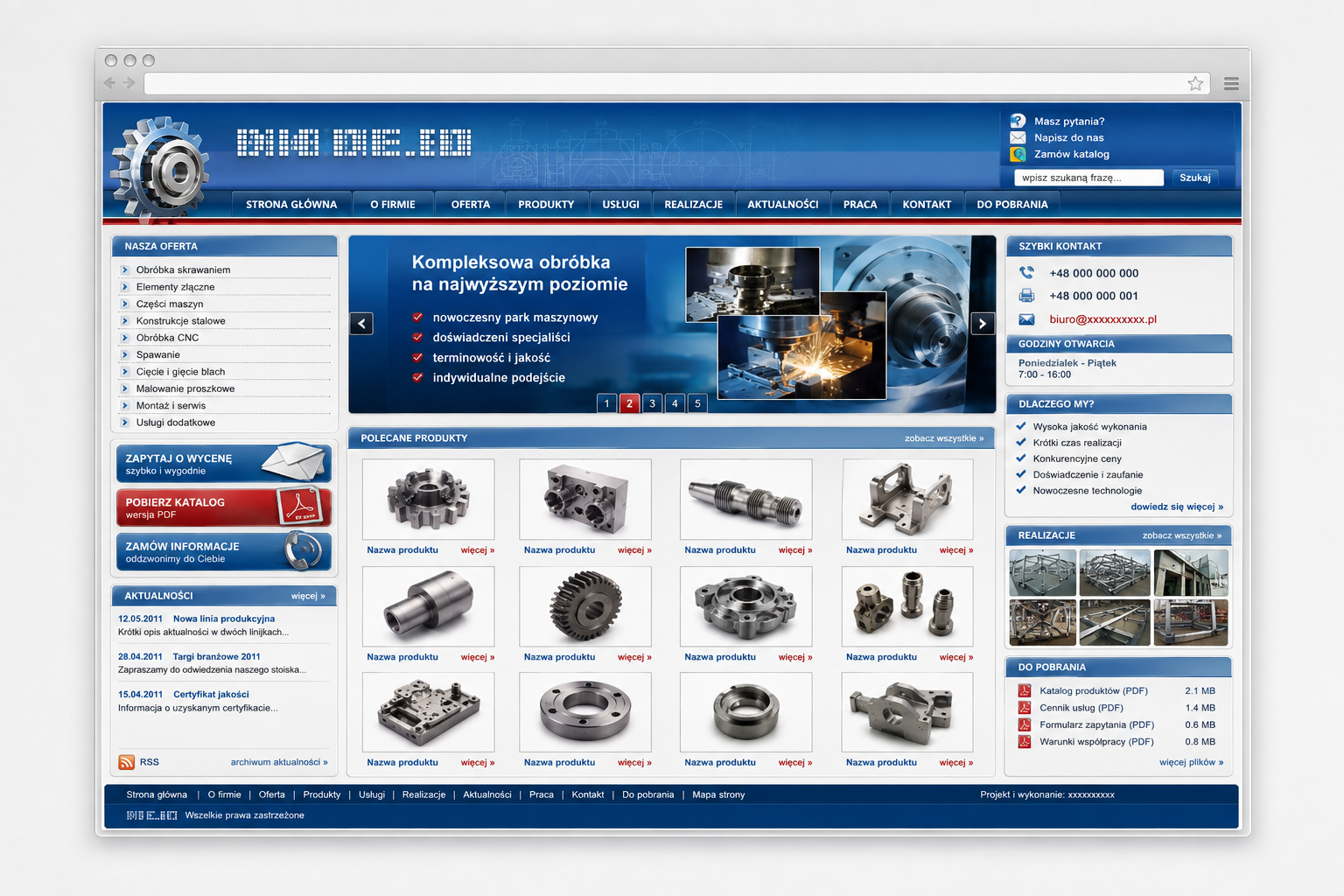
Move the handle to compare two fictional website directions: an older Polish-language presentation and a focused German market route.

Fictional modern German website mock-up for a precision manufacturing company
Fictional older Polish website mock-up for an industrial company
Older Polish-language presentationGerman market route

Both visuals are fictional AVOG concept mock-ups created for this comparison. They are not a critique of a real company.

Why a German market site?

A translated page is not yet a German customer journey.

German buyers need to understand your offer, evidence, delivery area and next step without reconstructing the meaning from a literal translation.

01 / Positioning

Say what German prospects need to know first.

We turn products, services and technical strengths into a clear page structure for the people who actually decide: buyers, partners, owners or project clients.

02 / Language

German wording with a reason behind it.

Specialist terms, proof points and calls to action are arranged for context. The result should read like a business that understands its market, not a page that was run through a translator.

03 / Discovery

Build a useful basis for search and answer systems.

Clear topics, named services, locations, industries, evidence and visible answers give search engines and AI systems more reliable information to interpret. No ranking or inclusion is promised.

04 / Action

Make the enquiry easy to qualify.

A German prospect should know whether to request a quote, book a call, send drawings, ask for a catalogue or contact a local representative. The form follows that decision.

What AVOG builds

One focused project. Four layers that need to agree.

The website can start small and grow with the German market. Its structure stays clear as products, sectors or regions are added.

01

German market message

Audience, offer, proof and next step are ordered around the German buyer's questions.

02

Localised website content

Pages, metadata, calls to action and terminology are created for the chosen market rather than duplicated from the home country.

03

Search and GEO foundations

Technical basics, internal links, structured facts and helpful answers support classic search and newer answer interfaces.

04

Qualified enquiry path

Contact, quote, booking or catalogue requests collect enough context to start a useful conversation.

How the project works

Clear enough to move across borders.

You provide the material and the commercial context. AVOG turns it into a structured German market website and shows you what needs a specialist review.

01

German market brief

We identify the audience, offer, region, evidence and action the site needs to support.

02

Content direction

We map pages, terms, proof points and questions before the design is filled with text.

03

Build and review

The pages, metadata, forms and links are assembled in a calm, reviewable visual system.

04

Launch and next steps

After approval, the agreed domain and contact path go live. Further languages or sectors can follow.

A clear starting point

German market presence without a hidden scope.

Website projectfrom €990 net
Three instalments3 × €390 net
Website subscriptionfrom €149 / month

The final scope depends on page count, language work, content, integrations and any specialist review. Hosting and ongoing changes are agreed separately. No ranking, lead or AI placement is guaranteed.

Configure a project
Questions

Useful answers before you send material.

Do we need a new German domain?

Not necessarily. A German-language route can live under a suitable existing domain, a country domain or a dedicated project domain. The choice depends on the company's market plan, brand and existing authority.

Can the German site remain connected to our existing website?

Yes. The site can link to existing booking, catalogue, CRM or enquiry systems. The goal is a clear German route, not an isolated translation island.

Can the German copy be reviewed by our specialist team?

Yes. AVOG can prepare the structure and copy direction and leave clearly marked points for technical, legal or product-specific review.

Does GEO mean that an AI system will list our company?

No. GEO is a useful way to think about clarity for answer systems, but no provider can guarantee inclusion. The practical work is to make the company, offer, evidence and answers easy to interpret.

Research basis

Good international content starts with verifiable context.

We separate a real market question from a keyword list. Official sources help frame the work; they do not predict demand for an individual company.

01 / Search intent

Build pages around a decision.

“Find German customers” can mean a distributor, a technical buyer, a project lead or a direct booking. Each needs different evidence, wording and next steps.

02 / Evidence

Make the offer inspectable.

Capabilities, applications, delivery areas, certificates and contacts are more useful than broad claims. Every fact should have a clear owner and scope.

03 / GEO structure

Answer the question in the page.

Definitions, short answers, visible FAQs and consistent company facts give people, search engines and answer systems a clearer source to interpret.

04 / Review boundary

Keep sensitive claims with specialists.

Legal, tax, medical, product-safety and regulatory wording is prepared for review rather than presented as a guarantee by a website project.

Primary sources and further reading
Google Search: localized versions · Google Search: helpful content · Google Search: AI features · Your Europe: providing services abroad
Sources provide context and guidance. They are not a promise of ranking, AI inclusion, leads or cross-border sales.
Start with the material you already have

Tell us where Germany fits.

Send your current website, the German audience you want to reach and any product, service or company material that should be considered. We will return with a focused next step.

Prefer email? service@avog.info

A domain without https:// is fine.
Optional: up to five PDF, JPG, PNG, DOC or DOCX files; maximum 8 MB in total.

Your message is sent to service@avog.info. We use the details to respond to this enquiry and do not promise a ranking, lead volume or AI placement.

New practical guides

The German route has two practical starting points.

Clear answers for companies abroad: how local discovery and a German website work together, and how a first enquiry should be structured.